Wencheng Bao

Ph.D. Student in Civil and Environmental Engineering

University of Illinois Urbana-Champaign

My research spans three areas: stochastic network science; transportation modeling, optimization, and policy; and EV charging behavior and resilience. I develop mathematical models, computational algorithms, and data-driven methods for mobility and infrastructure systems operating under uncertainty and disruption.

Wencheng Bao
01

About

I am a third-year Ph.D. student in Civil and Environmental Engineering at the University of Illinois Urbana-Champaign, supervised by Prof. Eleftheria Kontou. My work lies at the intersection of transportation engineering, operations research, electric mobility, network science, and data analytics.

I study how uncertainty, traveler behavior, charging demand, infrastructure disruptions, and decentralized decisions affect transportation and energy systems. My goal is to develop methods that support more reliable, resilient, and efficient mobility systems.
02

Research

Select a research area to view the field problem, visual overview, and corresponding publications.

Area 01 Stochastic Network Science Centrality and critical-node identification when network structure is uncertain.
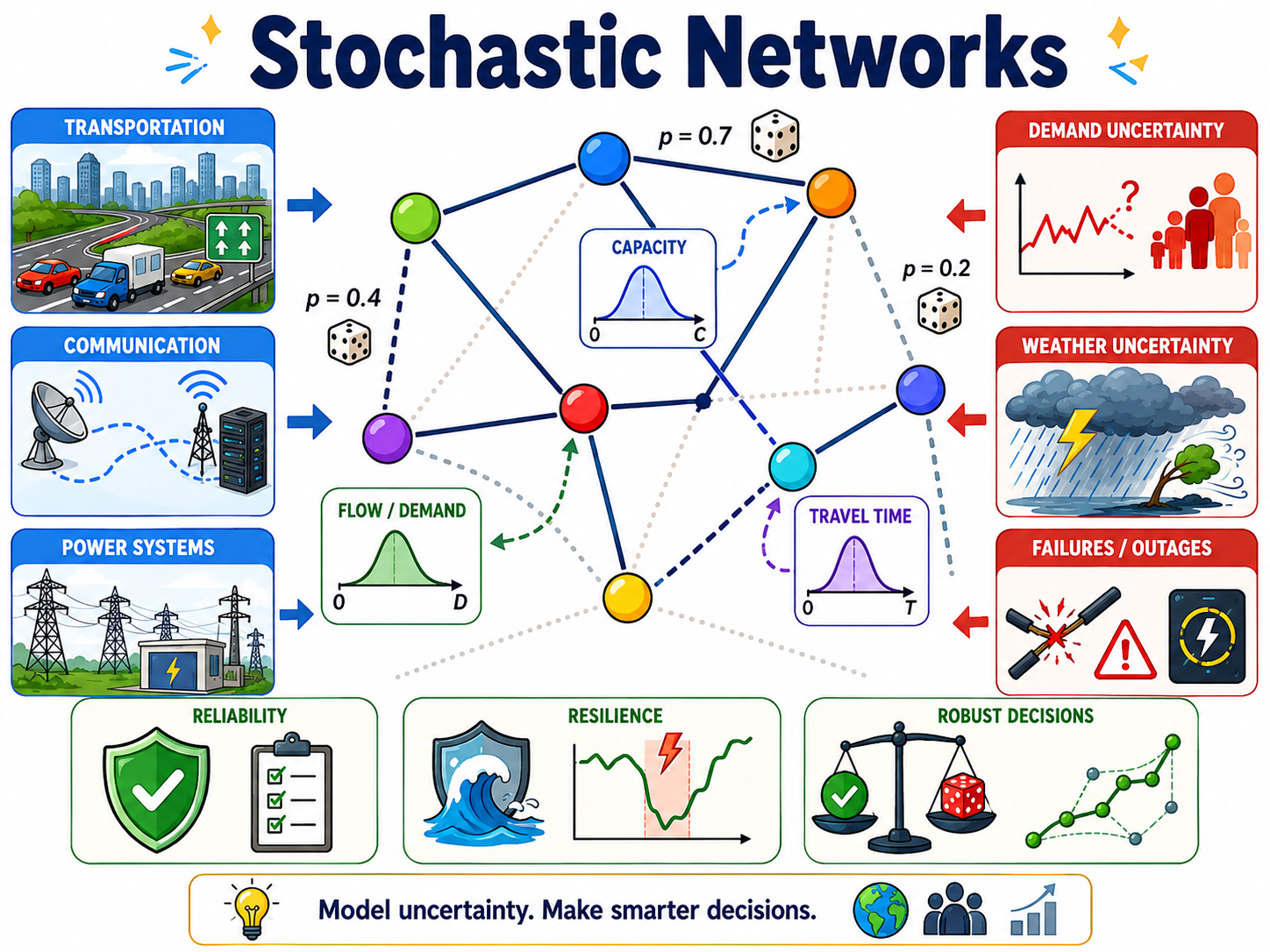
Cartoon infographic illustrating stochastic networks, uncertain links, random demand, weather disruptions, reliability, resilience, and robust decisions
Image generated by GPT.

A stochastic network incorporates randomness and probability distributions into its structure or attributes—such as treating edge existence, capacities, flow demands, or travel times as random variables rather than fixed values. We study them because real-world complex systems like transportation grids, communication networks, and power infrastructure are inherently subject to unpredictable demand shifts, weather disruptions, and random failures. By explicitly modeling these uncertainties, researchers can quantify system reliability, evaluate resilience under extreme events, and design robust, risk-averse decision-making strategies that prevent fragile failures in dynamic environments.

  • Computing Absorbing-Frequency Centrality: Complexity, Estimators, and Scalable Algorithms for Stochastic Networks

    Wencheng Bao, Eleftheria Kontou, and Chrysafis Vogiatzis

    arXiv preprint and Optimization Online, 2026

    Finalist (Top 3) — 2026 INFORMS Telecommunications and Network Analytics (TNA) Section Best Student Paper Competition

Area 02 Transportation Modeling, Optimization & Policy Traveler behavior, resilient network design, and multimodal policy evaluation.
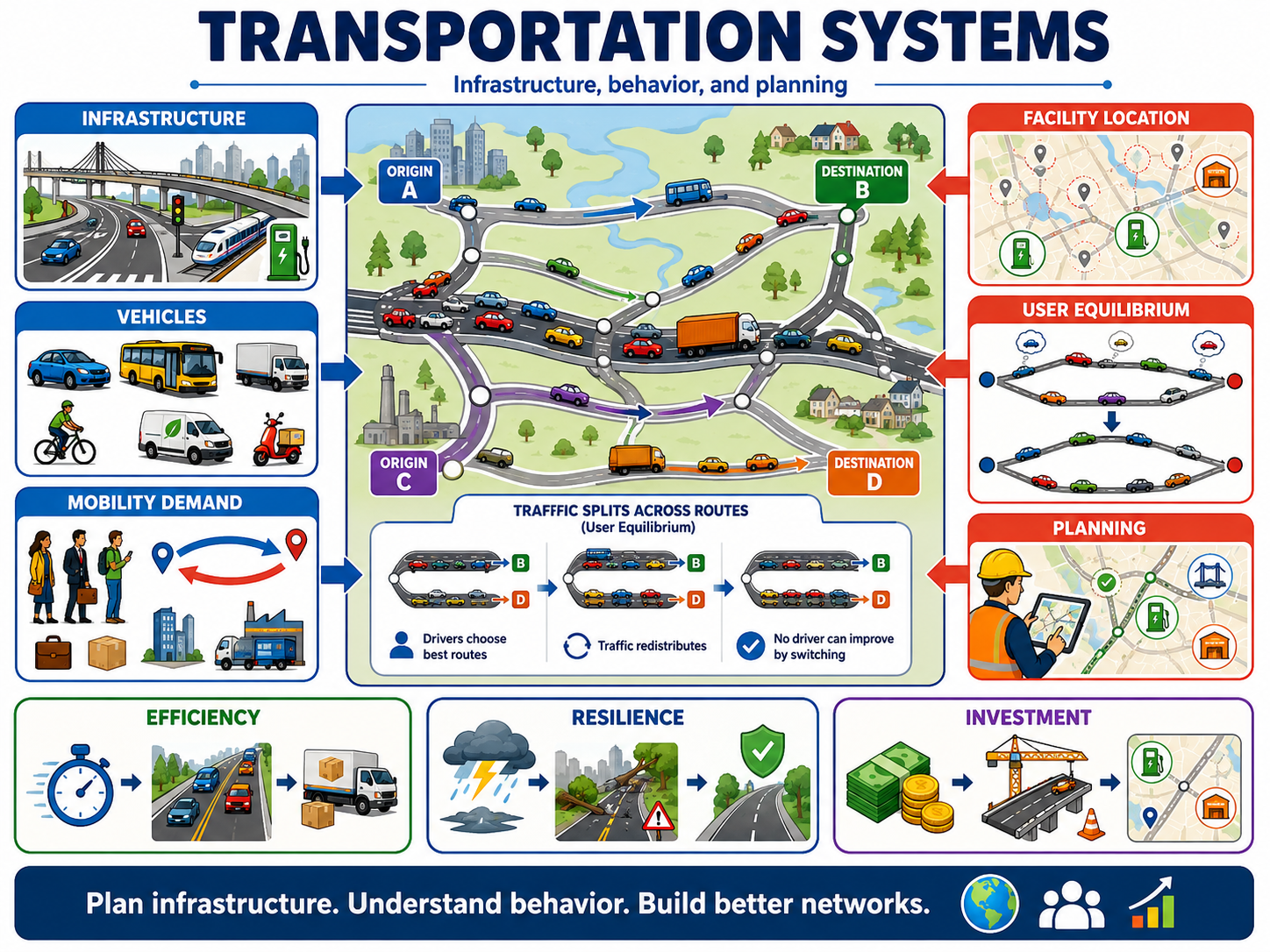
Cartoon infographic illustrating transportation infrastructure, vehicles, mobility demand, facility location, user equilibrium, planning, efficiency, resilience, and investment
Image generated by GPT.

A transportation system is an integrated network of physical infrastructure, vehicles, and mobility demands designed to move people and goods efficiently across space and time. We study these systems to maximize societal mobility, economic productivity, and network resilience by optimizing strategic infrastructure planning, such as solving facility location problems for EV charging stations or logistics hubs, and by understanding decentralized user behavior, like modeling user equilibrium to predict how self-interested route choices shape overall traffic flow. Ultimately, analyzing these mechanics allows planners to align system investments with actual human behavior to build efficient, robust transportation networks.

  • Risk-Averse Stochastic User Equilibrium on Uncertain Transportation Networks

    Wencheng Bao, Chrysafis Vogiatzis, and Eleftheria Kontou

    arXiv preprint and Optimization Online, 2026

    Honorable Mention (3rd price) — 2025 INFORMS OR/MS Tomorrow Mini-Poster Competition (Ph.D. Category)

  • A Bilevel Optimization Framework for Flood Resilient Electric Vehicle Infrastructure on Urban Transport Networks

    Wencheng Bao and Eleftheria Kontou

    Revise and Resubmit, Transportation Research Part C: Emerging Technologies

  • Weather-Time Heterogeneity in Congestion Pricing Effects: Evidence from New York City

    Wencheng Bao and Shanshan Liu

    Revise and Resubmit, Transportation Research Part A: Policy and Practice

Area 03 EV Charging Behavior & Resilience Charging-demand heterogeneity, hazard exposure, and infrastructure reliability.
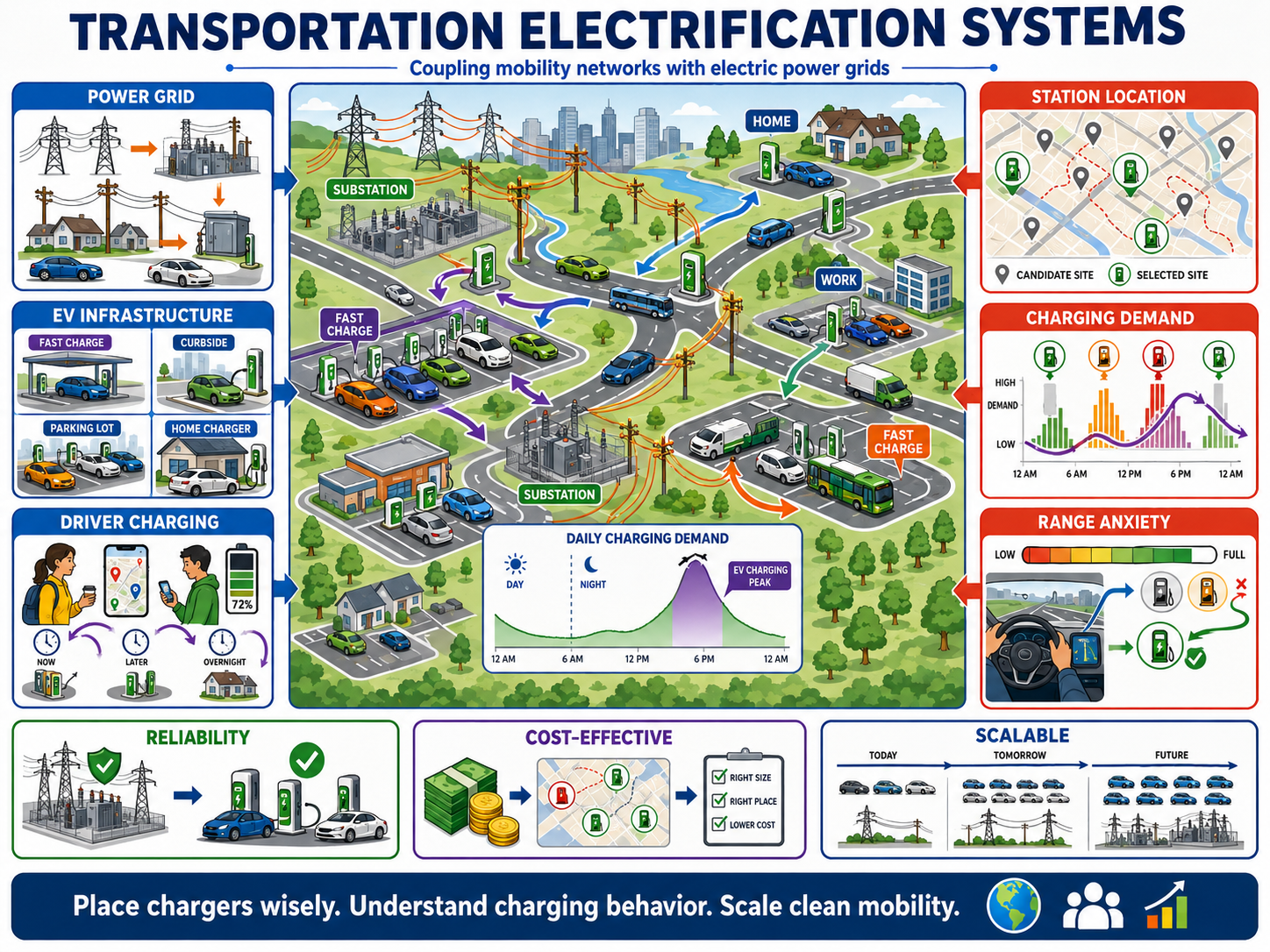
Cartoon infographic illustrating the coupling of electric mobility networks, charging infrastructure, driver charging behavior, and electric power grids
Image generated by GPT.

A transportation electrification system couples power grids with mobility networks through electric vehicle infrastructure and dynamic driver charging behaviors. We study electric vehicle infrastructure and user charging patterns because mass adoption fundamentally transforms both traffic networks and power grids, creating unprecedented spatial-temporal electricity demand peaks that can strain local transformers and cause severe grid congestion if left unmanaged.

  • Electric Vehicle Charging Stations at Risk from Hazardous Events and Power Outages: Analytics and Resilience Implications

    Wencheng Bao and Eleftheria Kontou

    Renewable and Sustainable Energy Reviews, Volume 226, Article 116144, 2026

  • Clustering Household Electric Vehicle Home-Charging Behavior Using Longitudinal Hourly Charging Data in Texas, Austin

    Wencheng Bao and Eleftheria Kontou

    Working paper, 2026

03

Recent News

  • Traffic Safety Scholarship.

    I received the Traffic Safety Scholarship from the Traffic Engineering and Safety (TES) Conference.

  • 2026 INFORMS TNA Best Student Paper Finalist (Top 3).

    Our paper, “Computing Absorbing-Frequency Centrality: Complexity, Estimators, and Scalable Algorithms for Stochastic Networks,” coauthored with Eleftheria Kontou and Chrysafis Vogiatzis, was selected as one of three finalists in the 2026 INFORMS Telecommunications and Network Analytics (TNA) Section Best Student Paper Competition.

    Read the paper
  • Upcoming presentation at the 2026 INFORMS Annual Meeting.

    I will present in the invited session “Traffic Assignment and Network Equilibrium” at the 2026 INFORMS Annual Meeting in San Francisco, California. The session is scheduled for Monday, November 2, from 1:15 PM to 2:30 PM.